


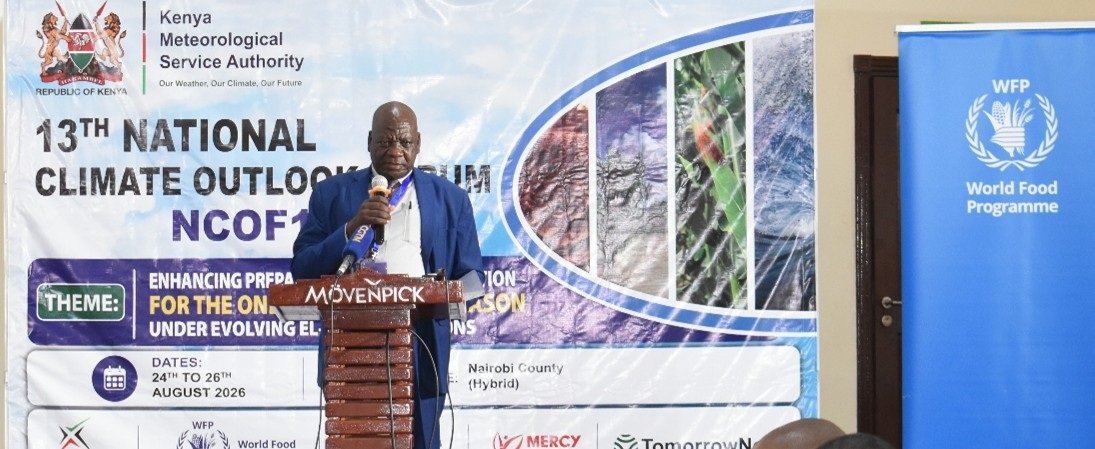
Kenya Meteorological Service forecasts above-average short rains for much of Kenya
Kenya is expected to receive above-average rainfall during the October-November-December (OND) 2026 “Short Rains” season, with enhanced rainfall forecast across much of the country, according to a technical statement from the Kenya Meteorological Service Authority (KMSA).
The statement, issued on August 26, 2026, says above-average rainfall is expected in a large number of counties, including Nairobi, Kiambu, Nakuru, Nyeri, Meru, Embu, Machakos, Makueni, Kitui, Garissa, Wajir, Mandera, Mombasa, Kilifi, Kwale, Kisumu, Kakamega, Bungoma, Kericho, Bomet, Narok and Migori. Near-average to above-average rainfall is forecast for Turkana and some parts of West Pokot, Samburu and Marsabit.
According to the KMSA statement, the OND season is particularly important for several parts of the country, including Garissa, Wajir, Mandera, Marsabit, Isiolo, Meru, Tharaka-Nithi, Makueni, Kitui, Taita-Taveta and Machakos, as well as parts of Kajiado and Tana River, where the season contributes more than 40 per cent of annual rainfall. Some areas can receive more than 700 millimetres during the period.
The rainfall outlook is influenced by several climate systems. KMSA says the season is associated with the southward movement of the Intertropical Convergence Zone, while the Indian Ocean Dipole and El Niño can significantly influence rainfall performance.
The Madden-Julian Oscillation and tropical cyclones over the southwest Indian Ocean may also affect rainfall intensity over shorter periods.
The weather agency says the 2026 El Niño event is continuing to strengthen over the central-eastern equatorial Pacific. The Niño 3.4 index reached a seasonal mean of +1.51°C during May-July, while the July monthly value rose to +2.03°C and the weekly index centred on August 12 reached +2.7°C, indicating a developing very strong El Niño event.
The Indian Ocean Dipole, meanwhile, remains neutral but is expected to strengthen. KMSA says the weekly IOD index stood at +0.17°C on August 23, below the +0.4°C threshold required for a positive IOD event.
The index is expected to surpass that threshold from September, although uncertainty remains over the timing and strength of the development.
Rainfall is expected to be fairly to well distributed across several parts of the country, although distribution in Turkana and Samburu is likely to range from poor to fair. The season is also expected to feature prolonged wet spells and occasional isolated storms.
KMSA forecasts that rainfall will continue from September into January in western and parts of the Rift Valley, while Nairobi and several central counties are expected to experience onset between the second and third weeks of October.
In eastern and southeastern counties, including Machakos, Kitui and Makueni, onset is expected during the third to fourth week of October.
The agency also forecasts relatively low probabilities of mild, moderate or severe drought across most of Kenya, although Turkana has a 15 to 20 per cent chance of experiencing mild drought conditions.
Temperatures are expected to be warmer than average during the OND season, with higher probabilities of above-average temperatures in Kwale, Mombasa, Kilifi, Lamu and parts of Tana River, Taita-Taveta and Garissa counties.
KMSA has urged stakeholders to follow subsequent forecasts and advisories, noting that short-term weather drivers can alter rainfall patterns during the season.
The OND outlook should therefore be used alongside daily, five-day, seven-day, monthly and special forecasts issued by the Authority and county meteorological offices.