


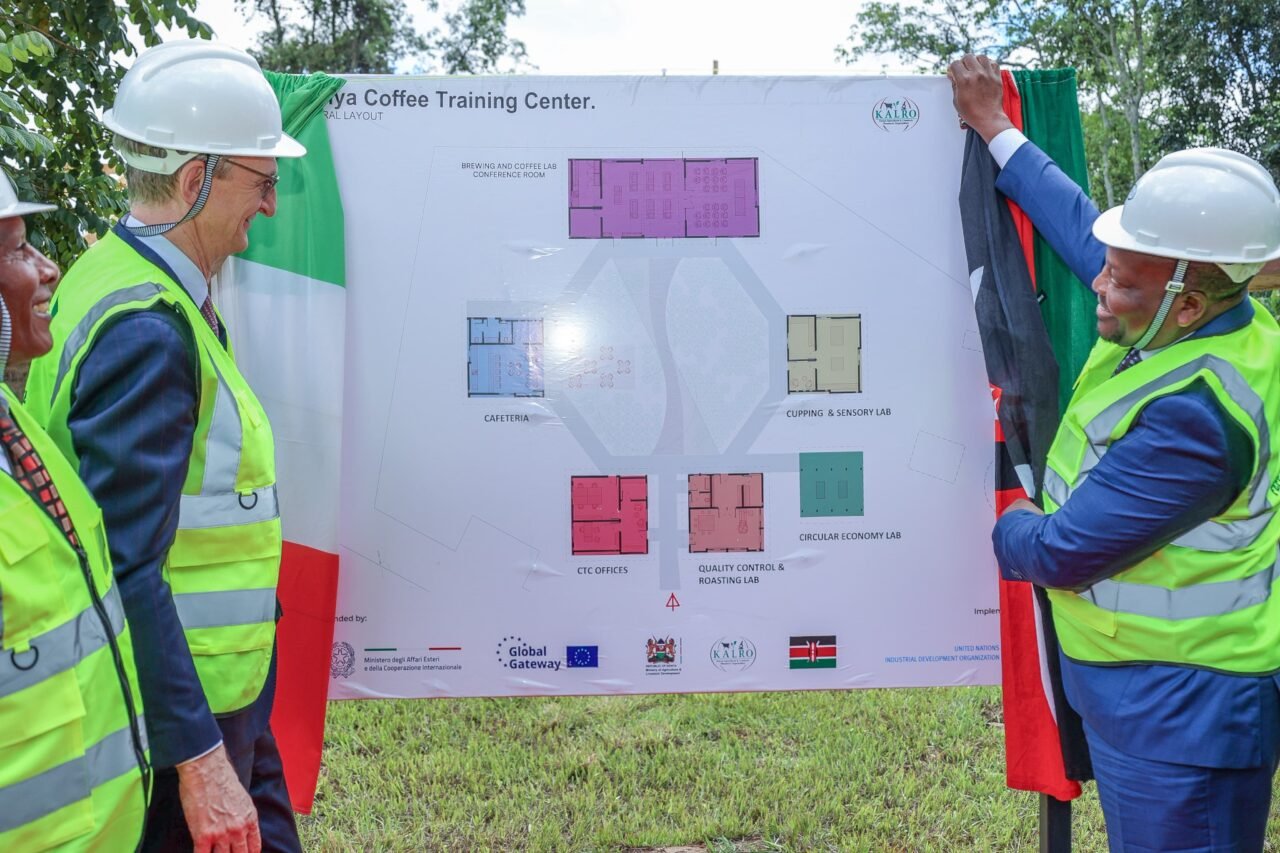
Kenya, Italy partner to build coffee training centre in sector revival push
Kenya has partnered with Italy to establish a coffee training centre at the Coffee Research Institute, in a move aimed at revitalizing the country’s coffee sector and boosting productivity, quality, and climate resilience.
The facility, whose construction has officially begun, is expected to serve as a hub for farmer training, research, and knowledge transfer, equipping growers with modern, sustainable farming practices to address longstanding challenges in the industry.
Speaking during the groundbreaking ceremony, Cabinet Secretary for Agriculture Mutahi Kagwe said the government is targeting to double coffee production from the current 49,000 metric tonnes. He noted that this goal will be achieved through a combination of farmer capacity building, strengthened research, and strategic international partnerships.
“The training centre will play a critical role in empowering farmers with the skills and knowledge needed to improve yields and quality, while also enhancing resilience to climate change,” Kagwe said.
Beyond increasing production, the initiative is also expected to support value addition and market diversification, enabling Kenyan coffee to access new and premium markets. The government is also keen on expanding coffee cultivation into emerging regions outside the traditional highland zones, a shift aimed at broadening the country’s production base.
Kagwe emphasized the importance of farmer-centered financing models, calling on financial institutions to develop tailored products that reflect the realities of agricultural cycles. He noted that access to affordable and flexible financing remains a key barrier for many smallholder farmers.
“Reducing the cost of production through innovative financing solutions will be essential in making coffee farming more attractive and sustainable,” he added.
The CS further underscored the role of research in driving sector growth, noting that the development and promotion of suitable, high-yielding, and climate-resilient coffee varieties will be central to improving both productivity and quality.
Italy’s Director General Stefano Gatti described the partnership as both timely and mutually beneficial. He highlighted the deep cultural significance of coffee in both countries and its potential to enhance farmer incomes while strengthening bilateral ties.
“This collaboration reflects our shared commitment to supporting sustainable agriculture and improving livelihoods,” Gatti said, adding that the training centre would serve as a platform for exchanging expertise and fostering innovation in the coffee value chain.
The partnership comes at a time when Kenya’s coffee sector is undergoing reforms aimed at reversing declining production and improving farmer earnings. Stakeholders are increasingly focusing on capacity building, research, and market access as key pillars for long-term growth.
Once completed, the training centre is expected to become a cornerstone of Kenya’s coffee revitalization strategy, supporting thousands of farmers with the tools and knowledge needed to compete in the global coffee market.