


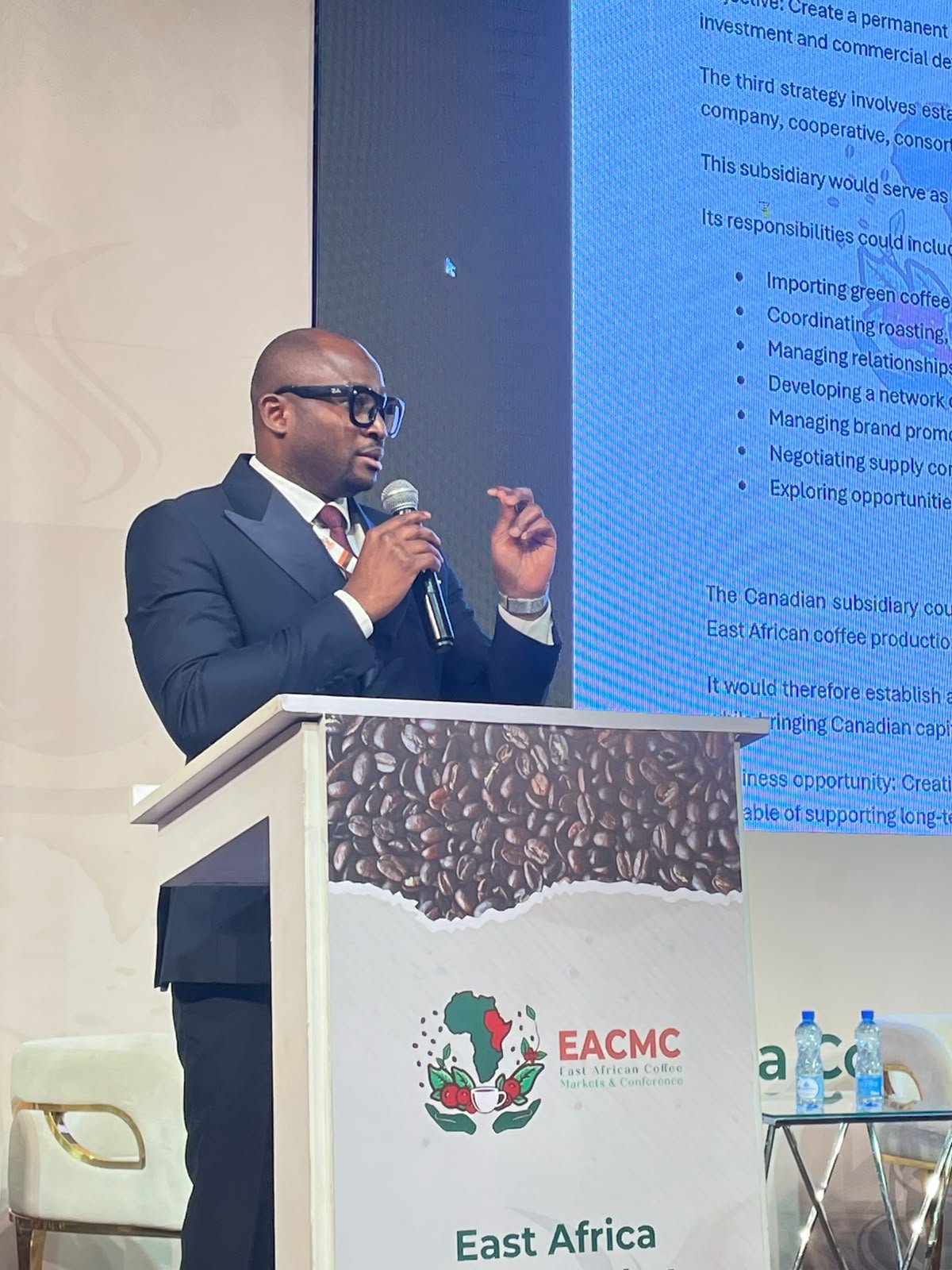
From cherry to opportunity, the defining lesson from EACMC 2026
The East Africa Coffee & Markets Conference (EACMC) 2026, held from 28–30 October in Nairobi, crystallised one clear truth that the East Africa must stop treating coffee as a raw commodity shipped abroad and instead build a complete coffee economy that retains value at origin, strengthens farmers, and invites the world to engage on equal terms.
The shift from cherry to genuine opportunity requires deliberate action that covers production, quality, financing, local consumption, regional collaboration and international partnerships.
Speaking on behalf of the State Department for Foreign Affairs, Edward Githaiga called for inviting global buyers, value-chain actors and roasters directly to Kenya.
“Let us not only take African coffee to the world; let us build a platform powerful enough to bring the world to African coffee,” he said.
The ambition extends beyond Kenya to the broader East African coffee belt. It brings Ethiopia, Uganda, Burundi, Tanzania, Rwanda and neighbouring producers onto a shared platform. Buyers, financiers, technology companies and investors must meet local farmers directly.
This approach can address issues of trust and decline while positioning Kenya as a regional hub where success is measured by connecting more credible buyers, mobilising finance, strengthening traceability, creating youth enterprises, retaining more value in Africa, and delivering better returns for farmers.
Drawing on family history, his grandfather Moses planted coffee in 1954 and helped establish the Othaya cooperative, he framed coffee diplomacy clearly. It links farm to embassy, embassy to market, and market back to value at origin.
According to Henry Kinyua, Chair of the Coffee Board of Kenya (CBK), there is need for tools to improve access to information and help people understand the full journey from cherry to cup.
“Production declined significantly between 1987 and 2021. Yet yields have improved in recent seasons, and farmers have received upwards of KSh100 per kilogram over the past three years,” he said adding that reforms have given growers greater control and added value.
He said the national target remains more than 150,000 tonnes of green coffee annually and achieving it requires continued support for production, research and financing through the Cherry Advance Revolving Fund and proper trade arrangements with banks.
“On the European Union Deforestation Regulation, the government is advancing geo-mapping and data collection. The information is expected by the end of November 2026,” said the CBK chair.
Kenya has been categorised as low-risk for traceability with Kinyua reaffirming the board’s commitment to regional partnership, open access, public data and better regulation.
Bernadette Murgor, CEO of Smart Farmer Africa and the conveners of EACMC said “Coffee deserves a stronger place in the market,” she said.
She emphasised that while information is essential, building strong relationships and addressing gaps across the entire value chain are equally important, with EACMC providing a platform to broaden ambitions and encourage candid conversations.
Closing the distance between farm gate and global premium
Kiprono Kittony, Chairman of Kenya Airways, focused on structural challenges that keep value from reaching farmers.
“Central Kenyan coffees command high prices on the world market. Yet the premium often fails to reach the farm gate. An espresso made from Kirinyaga beans, for instance, once sold for US$22 in Taipei, Taiwan,” he said.
Drawing lessons from Colombia’s cooperative system that averages 18 kilograms per tree, he argued that Kenya requires water at the farm gate, patient capital, improved agronomy and modern milling and roasting infrastructure.
“New growing areas in the Rift Valley and Western Kenya are expanding, but repeating the same methods will not close the value gap,” said Kittony
John Seronei, CEO of Sumseron Coffee and Tea, and Ambassador Peter Thuita, former Principal Secretary for Foreign Affairs, addressed commercial trust identifying persistent obstacles including mismatch between sample and final shipment quality, the working-capital squeeze between farm and port, and the need to honour shipping windows.
“There is need for commercial relationships progress from the first sale to repeat business, referrals and ultimately genuine partnerships, as buyers increasingly demanding complete traceability.” John Seronei
Thuita reminded participants that economic diplomacy requires every diplomat to act as a salesperson for Kenyan enterprise.
Quality as the foundation of opportunity
Dr Emmanuel Kimeu of the Coffee Research Institute showed that opportunity begins with rigorous quality from seed to cup saying that lots from the same society can sell for US$300 or US$120.
“The difference comes from variety choice, planting errors, ageing trees that yield only 1.8 kilograms, insufficient pruning, and moisture left above 10.5 percent,” said Kimeu.
Certified planting material, proper canopy management, soil analysis, same-day processing, raised drying beds and accurate moisture meters are essential.
“These practices protect the cup quality that already ranks Kenya second globally.”
Placing coffee sector challenges in historical context, Daniel Chemno, Board Chair of New KPCU said Kenya once ranked among the world’s top ten producers at 130,000–140,000 metric tonnes. Today it produces roughly 51,000–54,000 tonnes while Vietnam has surpassed 1.8 million.
However, he pointed out that recent reforms are beginning to reverse the decline.
These include training more than a thousand coffee champions, the Cherry Advance Fund, clearance of cooperative debt, and expansion into new regions and varieties.
“Combining elite quality with higher volume and stronger returns for youth and farmers remains the practical task,” he said.
From extraction to a living coffee economy
Mbula Musau, Chief Empowerment Officer of Utake Coffee and former board member of the Specialty Coffee Association and the International Women’s Coffee Alliance, described the deeper shift required.
“Africa has long been treated as a place of extraction rather than local consumption and shared value,” she said.
According to her, true growth demands a dynamic coffee economy built on value addition and domestic markets. It also requires training youth and women across the full chain—from agronomy and processing to roasting and barista skills.
Only when producers and local consumers enjoy the high-end value of the coffee they grow can the region move beyond being a passive origin on a map.
From being price-takers
High cupping scores, research advances and export volumes remain incomplete if farmers stay price-takers. East Africa cannot continue exporting raw potential only to import finished opportunity.
The defining lesson of EACMC 2026 is practical and urgent. Treat every stage from cherry to cup as one continuous value chain. Retain more value at origin through processing, branding and local markets. Equip farmers—especially women and youth—with information, finance and leadership.
Meet international requirements for traceability and sustainability. Build regional and global partnerships that bring the world to African coffee on terms of mutual respect.
When that work is done consistently, the journey from cherry to cup becomes the journey from cherry to lasting opportunity—for farmers, for communities, and for the East African coffee economy as a whole.